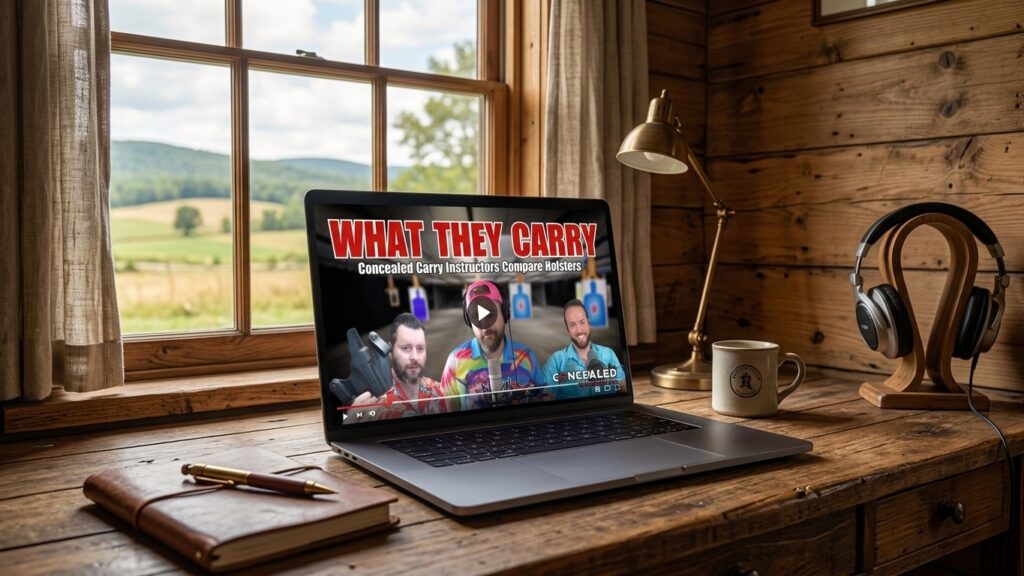
Behind the Holster is a Concealed Coalition podcast hosted by Jody Picou, a Concealed Coalition master trainer with more than 13 years of experience and over 100,000 students trained. This conversation is a members-only continuation of the open carry versus concealed carry episode.
Most holster arguments never get past preference. This one gets past it because the holsters are on the table. Jody Picou, Matt Wheeler and Yates Crawford, all Concealed Coalition trainers, work through duty rigs, leather inside the waistband holsters, Kydex, shoulder rigs and ankle holsters, and explain what each one is actually good at. If you want to build the skill that goes with the gear, you can find a class through the Concealed Coalition training network.
What Does Open Carry Retention Actually Require?
If you carry openly, a passive holster is not enough. The duty standard is an active retention device. Yates Crawford demonstrates a Safariland holster built around the ALS, the automatic locking system, where a lever has to be actuated before the pistol will release. Safariland produces these at multiple retention levels, and the practical difference between a level two and a level three is a hood that covers the top of the pistol. They are also made in smaller sizes for compact pistols and with a paddle attachment for belt wear, so a civilian who is set on open carry has real options.
There is a reason law enforcement carries with retention, and it is not bureaucracy. An exposed pistol is reachable by anyone standing next to you. Yates also pushes back on the most common argument for open carry: the deterrence claim. In his view a visible gun is not the deterrent people believe it is, because someone actually intent on committing a crime is not put off by the sight of a holstered firearm.
What Do Police Officers Do That Most Open Carriers Skip?
Matt Wheeler carried level two and level three duty holsters for five years, and he makes the point that retention is a habit before it is a piece of hardware. His instruction is to watch law enforcement during your day, and specifically to watch the officers who look squared away rather than the sloppy ones. Track the strong side forearm. It will be hovering an inch or two above the pistol through nearly everything the officer does, often pressing down on it. That is a deliberate point of contact, in place before anyone gets an idea.
The rest of it is body position. Blading your body, so the firearm sits angled away from whoever you are speaking to, is retention. So is how you move through a crowd and how close you let someone stand. If you are going to keep carrying openly, the recommendation from the episode is to train weapon retention as its own skill rather than assuming the holster covers it.
How Do Concealed Carry Holsters Retain a Pistol Without a Lever?
Almost all of them use friction or tension instead. You can buy a concealed holster with an active retention device, but then you have to build actuating it into every repetition of your draw. Yates prefers a friction fit with nothing to press.
Leather earned a bad reputation for a specific mechanical reason: on a conventional leather holster the mouth collapses once the pistol is out, which makes reholstering difficult and slow. Milt Sparks solved it by running a steel liner around the mouth so the opening holds its shape. If you want the comfort of leather at the three or four o’clock position, that is the version to look at.
The pivot over the last several years has been to Kydex. Yates shows a Tier 1 Concealed holster set up for a full size pistol with a weapon mounted light and an integrated magazine caddy, and a G-Code built for a micro compact. His most actionable note is about clips: for appendix carry, use dual clips or one genuinely wide clip. A narrow single clip lets the holster rotate on the belt, and a holster that moves between draws produces an inconsistent draw. Most major holster brands offer the upgrade at checkout.
Which Holster Works When the Waistband Is Not an Option?
Ankle carry is the honest compromise. There is no fast deployment from the ankle, and it will always be slower than appendix or strong side. It does conceal deeply, it works with jeans, slacks and khakis, and it avoids the discomfort of carrying on the waistline. Yates uses the framing that settles it: a gun on you beats a gun left at home.
Jody Picou draws his own line there. If he has to go down to his ankle in a fight, he is staying on the ground and fighting from there rather than getting back up. His alternative is a shoulder rig. Because the waistband is the first place anyone looks when they wonder whether someone is armed, moving the pistol to a shoulder position adds concealment instead of relocating the problem. He carries a Kangaroo Carry shoulder holster, made in the USA, from a company in business since 1996 and now in its thirtieth year. Matt Wheeler carries the same rig for the same reason, and notes that a tuckable inside the waistband holster gets clunky under a dress shirt in a way a shoulder rig does not.
For women, the episode is direct about the tradeoff nobody should have to make. Changing your entire wardrobe to accommodate a waistband holster is not a reasonable ask. A belly band or a shoulder rig removes the constraint, because neither one depends on what you are wearing. The Kangaroo Carry rig converts between the two and has a removable strap.
Yates adds one more piece of hardware worth knowing: the Ulticlip. It snaps into place and anchors the holster to your pants rather than your belt, so the belt goes on over the clips and the shirt can be tucked in on top. Holster brands generally offer it as an add-on at checkout. If you are shopping for any of this, the Concealed Coalition store carries carry gear.
Do You Still Need Training in a Permitless Carry State?
Permitless carry describes what the state requires of you. It says nothing about what you can do. Jody’s position is that the benefits of a training class are unchanged by the legal status of the permit, and that the conflict shows up specifically in permitless states, where people conclude that because no permit is required, no instruction is required either.
The test he offers is simple. Ask anyone who owns a firearm and carries whether it is possible to get enough training. Nobody says yes. Carry laws also vary considerably by state, and open carry in particular is legal in fewer places than many people assume, so verifying your own state law is a prerequisite rather than a formality. Start with the Concealed Coalition reciprocity maps or your state’s official .gov website.
Frequently Asked Questions
What is the Safariland ALS?
ALS stands for automatic locking system. It is an active retention mechanism built into Safariland duty holsters that locks the pistol in place until a lever is actuated, at which point the pistol releases and can be drawn. Safariland offers it at different retention levels, with the higher level adding a hood over the top of the pistol. It is available in sizes for compact pistols and with a paddle attachment, so it is not limited to full duty belts.
Is open carry a deterrent to criminals?
Not as reliably as many gun owners assume. The position taken on this episode by Concealed Coalition trainer Yates Crawford is that while nobody enjoys having a gun pointed at them, a holstered firearm sitting in plain view does not deter someone who has already decided to commit a crime. What it does reliably is tell everyone present that you are armed, which removes the element of surprise and makes you a first target.
Why do leather holsters collapse after you draw?
A conventional leather holster has no rigid structure at the mouth, so once the pistol is removed the opening folds shut under belt pressure. That makes reholstering slow and awkward, often requiring a second hand, and it is the single biggest reason leather lost ground to Kydex. Some makers, Milt Sparks among them, fix it by running a steel liner around the mouth of the holster so the opening keeps its shape after the draw.
Should I use one belt clip or two on an appendix holster?
Two, or one that is genuinely wide. A single narrow clip gives the holster a pivot point, so it rotates on the belt as you move and sits at a slightly different angle each time you go to draw. That produces an inconsistent draw, which is a training problem rather than a comfort problem. Most major holster makers, including G-Code, offer dual clips or a wider clip as an option at checkout.
Is ankle carry a good option for concealed carry?
It is a compromise, and it is worth understanding both sides of it. Ankle carry conceals deeply, works with most menswear, and avoids the discomfort of carrying on the waistline, which makes it viable for office environments and dress attire. The cost is speed: there is no fast draw from the ankle, and it will always be slower than appendix or strong side carry. It also assumes you can get down to it, which is not a given in a fight. As a rule, a gun on your ankle is better than a gun left at home, but it should not be your default carry position.
Where should women carry if waistband carry is not practical?
A belly band or a shoulder rig. Both remove the dependency on what you are wearing, which is the actual constraint when skirts, dresses or fitted clothing rule out a belt holster. A belly band sits under clothing and does not require a belt at all, and it tends to stay comfortable across a full day. Some shoulder rigs, including the Kangaroo Carry design discussed on the episode, convert into a belly band and have a removable strap, so one piece of gear covers both.
Do I need training if my state has permitless carry?
The law does not require it, and that is the only thing permitless carry establishes. A concealed carry class covers holster selection, drawing from concealment, defensive scenarios and the legal boundaries of using a firearm, none of which arrive with the purchase of a gun. Concealed Coalition trainers on this episode are unanimous that the answer to “can you ever get enough training” is no, regardless of what your state asks for.
So Which Holster Should You Actually Buy?
The one that matches how you carry, with retention that matches how you carry it. If you carry openly, that means an active retention holster like a Safariland ALS, plus the forearm and body positioning habits that make retention continuous rather than mechanical. If you carry concealed, a friction fit holster is simpler and faster, whether that is leather with a reinforced mouth or Kydex, and the clip matters as much as the shell: dual clips or one wide clip for appendix carry, so the holster does not rotate between draws.
If the waistband will not work for your clothing or your job, a shoulder rig or a belly band solves it more cleanly than an ankle holster, and conceals better because the waistband is where people look first. Ankle carry remains a legitimate fallback rather than a default. Whatever you choose, the gear is the smaller half of the answer. The habits and the training are the part that carries over between holsters.
You can find a class near you through the Concealed Coalition training network, or start with the free resources on the Behind the Holster landing page.